A pledge each morning
One tap, with your reasons in front of you. Just for today — you never have to decide about forever.
 Next Round
Next Round counts your sober days, keeps hold of why you started, and gives you an AI coach to talk to at any hour — without an account, and without telling anyone who you are.
Coming to the App Store.
iPhone & Apple Watch · No account · Free to start
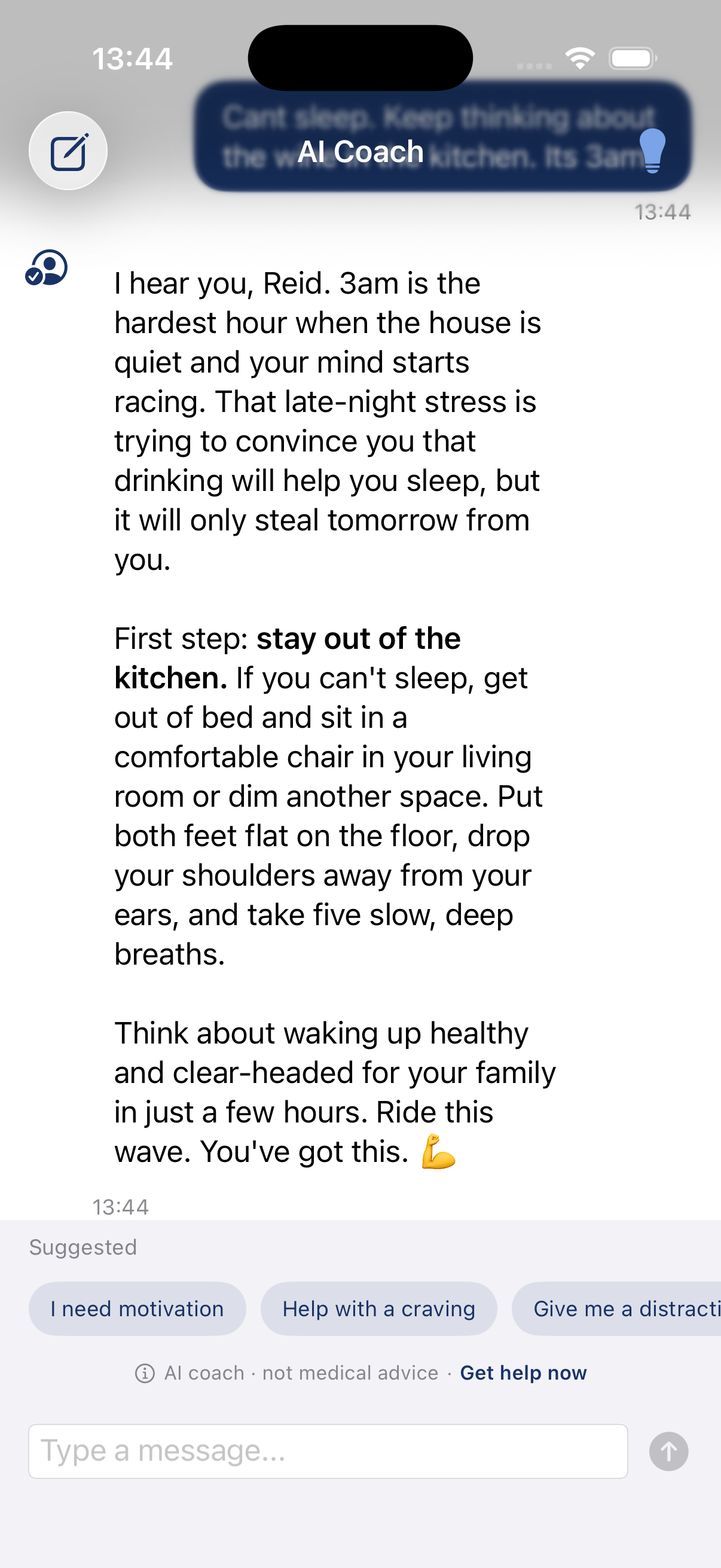
The hard moments do not keep office hours. They arrive on a Tuesday night, after a bad day, when everyone you could call is asleep.
Next Round gives you somebody to talk it through with — a craving, a fight, the meeting you are avoiding, or just that today was hard. It knows what you told it about your triggers and the reasons you started, so you are not explaining yourself from scratch every time.
It is built not to lecture, and not to shame you if you drank. If you are in real trouble it stops and points you at a person.
What you say is never written down. Not on your phone, not on our servers. The conversation exists while you are having it and then it is gone, so we hold nothing that could be lost or handed over. Your messages do reach Google's AI to be answered, under Google's terms — that part we do not control, and we would rather tell you than let you assume otherwise.
Free for your first 30 days.
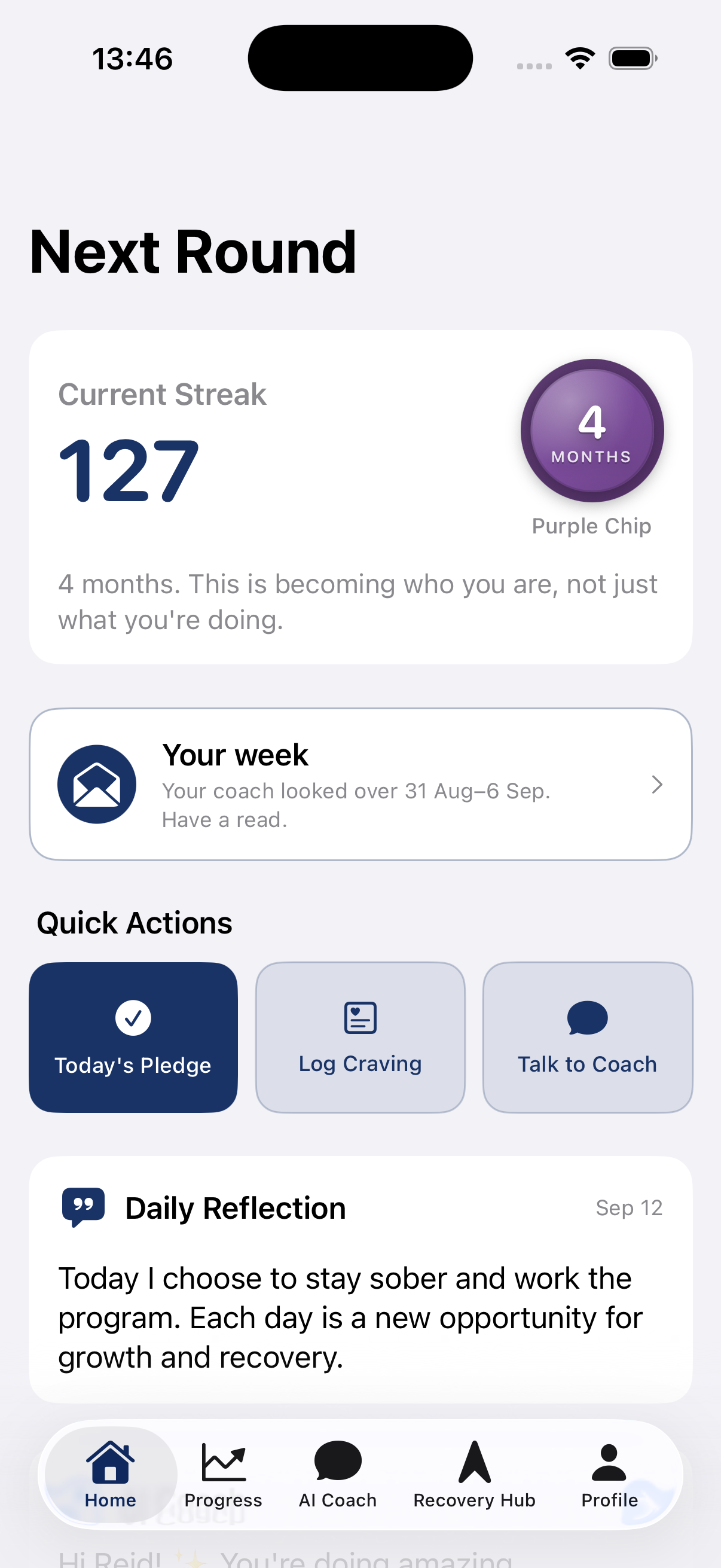
One tap, with your reasons in front of you. Just for today — you never have to decide about forever.
The people and the plans you are doing this for. They appear when you pledge, which is exactly when they help. They never leave your phone.
A running count and the milestones as they land — 24 hours, a month, a year. The number that matters, always one glance away.
A short look back at the day and a plan for tomorrow, carried into the next morning's pledge.
Note a craving when it hits. Over time you can see when they come and what tends to set them off.
Routines that hold a day together, and short challenges when you want something to aim at.
Widgets and an Apple Watch app, so the count is there without opening anything.
A morning nudge to pledge and an evening one to close out — with quiet hours, so it never wakes you.
Twelve Steps, Big Book readings and meeting finders are all in here. Available if you work that program, out of the way if you do not.
Four things, and only the first one is a decision.
Today, or the day you last drank. It is the only thing the app needs to know about you.
One tap, with your reasons in front of you. Just for today — you never have to decide about forever.
Any hour. It remembers your triggers and forgets the conversation.
A short look back, and a plan that meets you at tomorrow's pledge.
Recovery is nobody else's business. This app is built so that even we cannot see it.
Messages do travel through a server we run on their way to the AI that answers them — that is what keeps the key out of the app. It stores no conversations and logs no message content. Read exactly what it does.
People ask this more than anything else, and the honest answer is that it varies enormously. What follows is the general shape most people describe — not a promise, and not a measurement of you.
Often the hardest, and often the one where sleep gets worse before it gets better. Cravings tend to arrive in waves rather than as a constant, which is why riding out twenty minutes is a real strategy rather than a platitude. If you have been drinking heavily every day, this is the stretch where stopping without medical advice can be genuinely dangerous — withdrawal can cause seizures. Talk to a doctor before you stop.
Sleep usually starts to settle. Many people notice they are less anxious in the mornings, and that the low-level dread some drinkers wake up with begins to lift. Money is often the first thing people find concrete: a habit of two drinks a night is somewhere around $400 a month, and seeing that number is frequently more motivating than any health argument.
This is where most people describe it stopping being something they are attempting and starting to be how they live. Social situations get easier, usually because you have been through a few of them sober and know it is survivable. Mood can still dip — that is common and usually temporary.
None of this is medical advice, and Next Round does not track your health or make any claim about it. If you are worried about anything, talk to a doctor.
Plenty of people stop without ever going to a meeting, and plenty of people try a meeting, find it is not for them, and conclude that means they are out of options. They are not.
Next Round does not require you to join anything, follow any steps, or believe anything in particular. It asks for one thing: a decision about today. The Twelve Steps, the Big Book and meeting finders are in the app if you want them, and entirely out of the way if you do not — alongside non-program resources like Rethinking Drinking from the National Institute on Alcohol Abuse and Alcoholism, SMART Recovery, and FindTreatment.gov.
If you are cutting down rather than stopping, the same daily count works — nothing in the app tells you what your goal has to be.
The hard moments do not keep office hours. They arrive on a Tuesday night, after a bad day, when everyone you could call is asleep. That gap — between the craving and the next time you can talk to a person — is the thing this is for.
It is software. It can be wrong, and it says so. It does not replace a sponsor, a counselor, a therapist or a doctor, and it will not give you medical advice. What it will do is answer at 3am, remember what you told it about your triggers, and not judge you if you drank.
It is also built to forget. Conversations are never written down — not on your phone, not on our servers — so we hold nothing that could be lost or handed over. Your messages do pass through Google's AI to be answered; that is the one part of the path we do not control, and it is described exactly in the privacy policy. The trade is real: it will not remember yesterday. We think a coach with no memory beats a transcript of your worst nights sitting on a disk somewhere.
Yes, and more so than most apps. Conversations are never stored — not on your phone, not by us. They exist while you are having them and are gone when you close the app. Messages do pass through a server we run on their way to the AI that answers them, and that server keeps none of them.
No. Plenty of people stop drinking without a twelve-step program, and the app works the same either way. The Steps, Big Book and meeting finders are there if you want them, and out of the way if you do not.
It does not end anything. You set a new start date when you are ready, and the app counts from there. There is no button that marks a day as a failure, and no shaming language anywhere in it. Relapse is common and it is not a failure of character.
No. It is software and it can be wrong. It does not replace a real sponsor, a counselor or a doctor, and nothing it says is medical advice.
No. Your progress is included in your device backup, so restoring a new phone or transferring from an old one brings it with you. The one thing worth writing down somewhere safe is your sobriety date — everything else is calculated from it.
Counting your days, the daily pledge, your reasons, the milestones, the checklists and every crisis resource are free and always will be — no trial, no card. The AI coach is free for your first 30 days, then $29.99 a year or $6.99 a month. Nobody is ever locked out of help because they have not paid.
Not yet. Next Round is iPhone and Apple Watch for now.
You do not have to decide about forever. Only about today.
Coming to the App Store.
If you are in crisis, please call 988 — a person will answer, free and at any hour.